
Brasilidade Empresarial · Interview
Everton Corte, the Brazilian transforming the commercial vehicle industry. A conversation about leadership, brasilidade and the part luck plays
Published on 31 March 2025. Interview by Fabiana Di Pietro. Originally published in Portuguese; this is a translation.
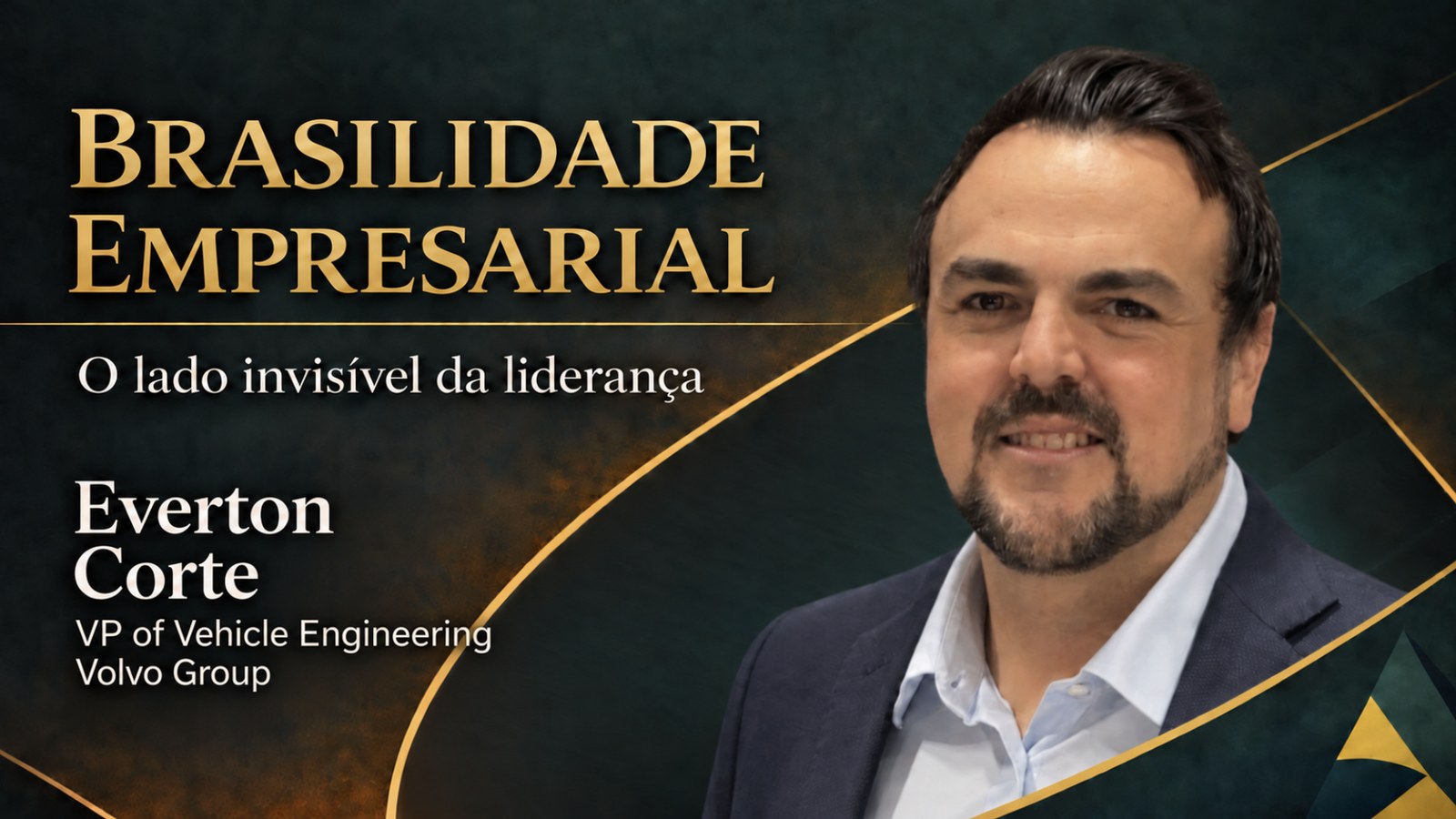
Everton Corte is one of the voices and driving forces in the transformation of the truck and commercial vehicle industry. With more than two decades of experience, he has led global teams on initiatives that redefined standards of innovation and sustainability in the automotive sector. His career is marked by strategic projects and by the introduction of pioneering technologies such as zero-emission vehicles (BEV and FCEV), digitalisation and connectivity.
Starting his career in automotive engineering, Everton took an international path, gathering experience in several markets including Brazil, South Africa, Germany and Italy. He is known for bringing multicultural perspectives together, building high-performing teams and turning complex challenges into innovative solutions.
Alongside his technical expertise, Everton has devoted himself to shaping the leadership of the future, combining strategic vision with an adaptable, transformational approach. He is now taking on a new challenge at one of the world's largest automotive groups, confirming his place among the leading names in the reinvention of sustainable transport.
Before we talk about your new professional challenge, I would like to step back and understand more about your journey. How would a childhood friend describe the ten-year-old Everton?
The ten-year-old Everton was pure energy! Endlessly curious, restless and never satisfied. Always wanting more, thinking more, doing more. A hurricane, frankly. And honestly? I do not think that has changed all that much.
Useful qualities for leadership. Was there already a sign that you would become a leader?
I think so. I was always good at solving problems. I was so restless that when there was no problem, I would invent one to solve. I also found it easy to communicate and often ended up influencing the people around me. I remember the complaints at school were always the same: he learns fast, finishes his work before the others and then “sets the playground on fire". My friends always joined in.
In time I learned how to channel that energy, and I realised that people are influenced more by what we do than by what we say. I think those traits were already pointing me towards a leadership role, even if back then I did not really understand what that meant.
How did you discover leadership? Do you remember a particular experience?
There were several that stayed with me. But the first time I felt the real weight of leadership was when I took my first coordination role and suddenly found myself leading many of my friends. Separating personal from professional life was hard, and it taught me some difficult lessons.
I learned that leading is not just dividing up tasks in the way that makes sense to you, but recognising the differences between people and, with simple, clear instructions, drawing the best out of each of them within a context, a team, a mission. However much that idea appears in books, training and theory, you only absorb it in practice. I realised my view of leadership was narrow and that I had to learn, adapt and develop quickly. Since I became a manager very young, that learning came fast.
What was that path like, and how did your upbringing shape it?
Much of what I learned comes from my upbringing and from where I come from. My parents had no formal education, but they always understood that education was a means of transforming a life. I grew up being encouraged to seek knowledge as a route to a different future. My mother had a protective kind of leadership: she wanted to make sure we were ready to face the world. My father, on the other hand, was an innovator, always trying to create solutions and build businesses, with that restless spirit and appetite for reinvention. I took a little from both sides, and it shaped the way I think and lead today.
You spoke about education as a means of transformation. How does that show up in your daily work and in your view of leadership?
For me, learning shapes lives. I always pay attention to what is going on around me, trying to learn from the experiences I have. I learned that even coming from an environment where taking things personally can drive your chances of success, you have to know how much of it to allow. When you take everything to heart, particularly in corporate settings where not every intention is good, you end up absorbing the negative side of leadership and of corporate life too.
At the same time, I learned that negative things only affect you if you let them, because we always have the option of stepping away. From that realisation, not only through my experience of leadership but through how I see the world, I came to understand that we can indeed separate the personal from the professional. Not only can we, we should. It strengthens both sides and helps me adapt my leadership to the situation. That ability to switch, to adjust according to circumstances, is essential to leading effectively.
So you think of a personal Everton and a professional Everton. Who is each of them? How do you separate, or integrate, the two sides?
I try to keep the two worlds in separate compartments so as to have the best chance of being good at both, though sometimes I do end up mixing them. To explain it, I like to use the philosophy of yin and yang, which represents the coexistence of opposites that complement one another: light and shadow, activity and rest, reason and emotion.
At work, the 'yang' is action and focus on results, while the 'yin' is calm, empathy and adaptability. That balance is essential to avoid both burnout (when yang dominates) and stagnation (when yin does). In personal life, the "yang" might show up in personal goals or family projects, while the "yin" is rest and self-care. The key is adjusting the flow to what the moment needs. In demanding global settings, that is what lets me protect my mental health and my own sense of satisfaction.
What do they not tell you about being a leader?
I do not think many of my own leaders prepared me to lead in the way that the people I have led helped me learn it. I believe becoming a leader is, above all, the ability to look not only upwards and admire a leader, but also sideways and ask yourself: "How can I become a better person, so as to create a healthier environment for everyone around me?" For all the emphasis placed on mentoring and coaching, what really matters is investing time in listening to your team and the people around you. That is my idea of leadership.
There is also no fixed recipe for leadership. You will only be a good leader if you can connect with the energy the environment needs, in step with the company's history and with the group. If a leader stops developing while the environment and the people around them change, they will not keep the effectiveness and relevance they once had. My view is transformational: the leader is always in transition, adapting to be what is best for the company, the situation and the group.
On transformational leadership, what contribution is expected of you at Volvo, and what is your view of the world of trucks? What is your first challenge?
The automotive industry is going through an unprecedented moment of non-linear change. To give you an idea, the sector, and trucks in particular, will develop more in the next five years than it has in the past twenty. We need more dynamic solutions, without losing efficiency or stability. That process of change is demanding, because how do you explain to an industry that has succeeded for fifty years that it now has to transform and go further still?
That process fits closely with my recent experience, where, for example, we had to grasp that the truck was no longer the product in itself: the performance it delivers was. I would say the mobility industry is going through a transformation as radical as the one telephony went through some years ago with the arrival of the smartphone, a device that is now far more than something you make calls on.
That transformation is what companies are aiming at now. In my case, it was luck to be in the right place at the right time and to join that new journey in such an important group in the sector.
What exactly do you call luck?
I have a slightly different idea of luck. My father always used a line that I am sure was not his own, but which stayed with me: "The harder I work, the luckier I get." Luck is not passive, it is tied to effort, dedication and resilience. I actively sought learning and change at every stage of my career. And I can say that every stage reinforced my belief that luck is something you create actively, not passively. It does not happen by chance, but when we are willing to open ourselves to experience, and it is certainly also shaped by my brasilidade.
Interesting. And how do you see that brasilidade? What is Brasilidade Empresarial to you?
The first time you mentioned it to me I started thinking about it, and after a good deal of thought I arrived at my own way of understanding brasilidade, which I divided into four areas:
• The strength of community and connecting through differences: brasilidade taught me that diversity is our greatest strength. We grow up used to living with contrasts and learn to turn differences into points of connection, which makes us diplomatic, adaptable and intuitive in managing people. In practice, whether leading multinational teams in Germany with more than 20 nationalities, or local teams in South Africa or Brazil, I learned that diversity is not just representation, it is power.
• Creativity applied to problem-solving: there is a genuinely Brazilian way of navigating uncertainty and coming up with innovative solutions. In a global corporate environment that becomes innovation and flexibility, and I have seen it at work in strategic negotiations, in product development and even in running organisational change.
• Resilience: Brazil teaches us to be resilient from an early age. We grow up in an environment that demands flexibility, improvisation and persistence, which shapes us to see challenges as chances to learn. When I think about the difficulties I have faced, I see that it was that resilience that let me keep going and turn hardship into progress.
• Empathy: there is a distinctive way of relating to people that we carry with us wherever we go. In Brazil we learn to read the context, catch the nuances and build genuine connections. In business, that skill is often the difference between a formal transaction and a lasting partnership.
Once I had set out those four areas, I realised they are not just individual traits but strategic assets in the global corporate world. Brasilidade, well applied, gives us a competitive advantage that goes far beyond charm or hospitality. It shapes how we lead, how we innovate and how we build relationships of trust anywhere in the world.
I imagine other cultures have their own qualities, different but every bit as powerful. I understood mine once I had defined them through brasilidade, after talking to you. So this is an invitation to the readers of this piece to set out their own in the comments.
To finish, what advice would you give the next generation of leaders?
Three things.
Believe in yourself and follow your dreams. Confidence is the foundation of any journey.
Open yourself to opportunities and to diversity. Connect through differences: it will add value for you and for others. Many people, when they go abroad, try to connect with others through similarities. That is human nature, but it is not what I found brings the best results. Do not be the person who tells the same stories or follows the same examples. Explore the potential of differences. I was reading a book called "The Culture Map: Breaking Through the Invisible Boundaries of Global Business", by Erin Meyer, which made me see how powerful it is to learn to connect through differences. She sets out a practical model for getting past cultural barriers, which is essential in global environments.
Allow yourself to treat experiences as learning. Do not lose heart if things do not happen straight away. Every experience is a chance to learn. Use those experiences as a way of adding value to yourself.
Those are the three things I would advise, although if advice were such a good thing, we would not need to give it away, would we? (laughs).
Are you a Brazilian leader working in Italy or in Europe?
The Brasilidade Empresarial Executive Community brings together Brazilian executives to share experience, widen connections and turn individual journeys into collective intelligence.