
Brasilidade Empresarial · Interview
Leonardo Capdeville: CTO of TIM Italy, the invisible side of leading as a foreigner at the centre of decisions
Published on 3 February 2026. Interview by Fabiana Di Pietro. Originally published in Portuguese; this is a translation.
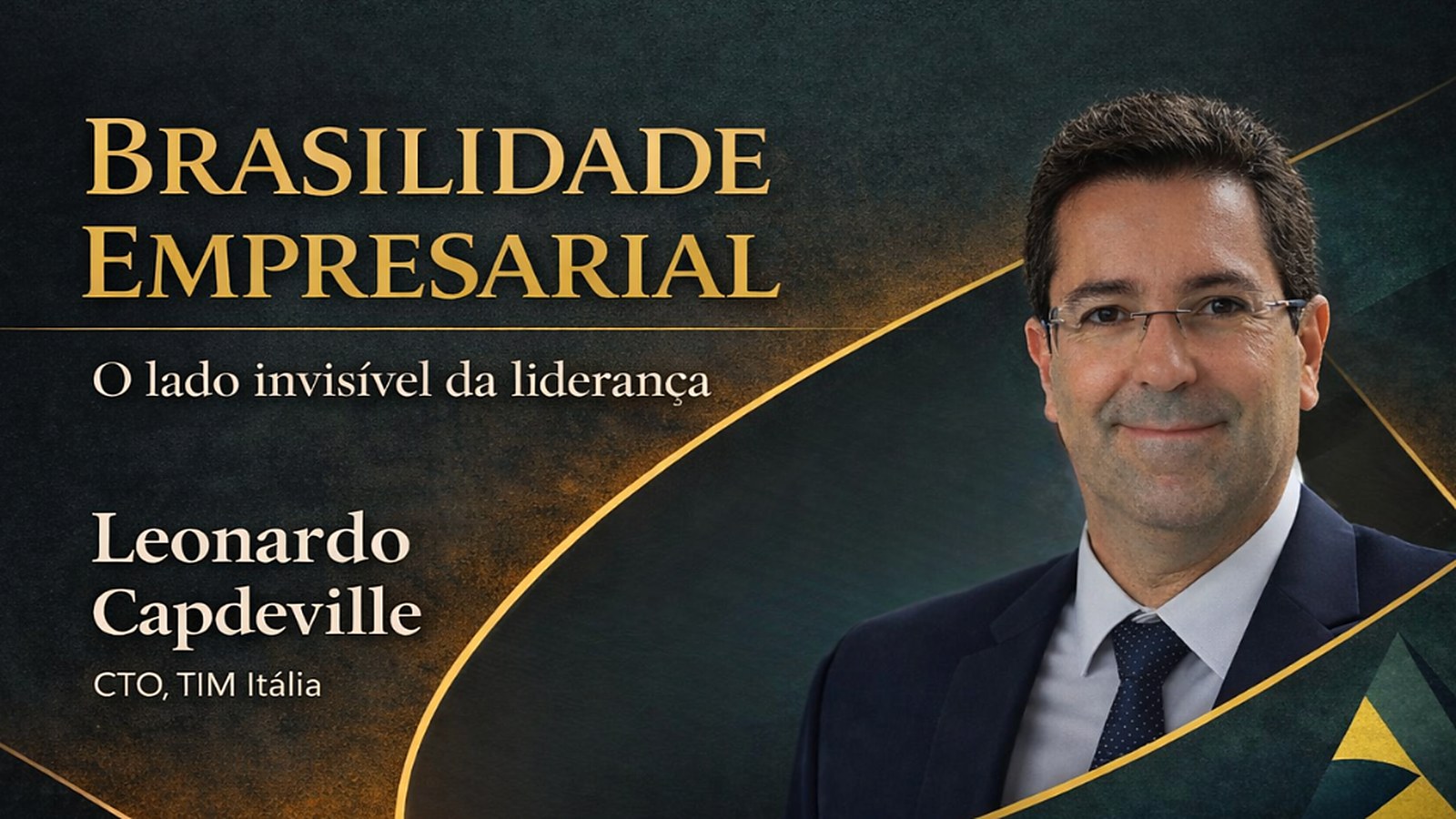
Leonardo Capdeville leads technology at one of Europe's largest telecoms operators. But there is something unusual about his path: he was the first Brazilian C-level executive in TIM's history to make the journey in reverse, leaving Brazil to take a strategic seat at the Italian headquarters.
After ten years as CTIO of TIM Brasil, he moved on to lead technology in Italy, in one of the most heavily regulated markets on the continent. A transition that looks technical from the outside but is, on the inside, profoundly human.
In this conversation we talk about what changes when you become the foreigner in a position of power. About decisions taken at the edge of uncertainty. And about the invisible dimension of leading in another language, another culture and another logic.
Looking at your career, ten years heading technology at TIM Brasil and now CTO of TIM Italy, I would like to go back to the beginning to understand what set that path in motion. Before any post or title, who was the Leonardo who left Vitória to study at Inatel?
He was a frightened Leonardo who landed in telecommunications almost by accident. All I knew was that I wanted to study engineering, because I always liked the exact sciences, and mathematics above all, which I saw almost as a game, a challenge. And I liked being challenged.
It was an aunt of mine who lived near Santa Rita do Sapucaí who mentioned a really good college there. She invited me to see it and when I visited it was almost love at first sight. It was a welcoming university and everything about it charmed me.
I remember that when I came back from the entrance exam I said to my mother: “I do not know whether I will get in this time, but if I do not, I will try again next year. This is what I want to study.
One curious thing I never understood is that, despite being more than a thousand kilometres from Espírito Santo, there were always around 10% of capixabas in the Inatel year groups, practically a community.
In those days we had no mobile phones, no internet. I spoke to my parents once a week from a payphone and lived in a shared student house with fourteen others, all from different parts of Brazil.
But that was where I had one of the best times of my life, and where I learned something fundamental: you depend on people. You have to build relationships, form bonds, build a network. That marked me deeply.
Speaking of special moments and relationships, you were the first C-level executive from TIM Brasil to take a leadership position at headquarters. What changes psychologically when you become the foreigner in a strategic seat?
Things happened not because I planned everything out in a structured way, but because I always lived moment by moment, taking one opportunity after another. And because I always had that restlessness, a wish to do something different, to challenge myself.
After I graduated, in the first years of my career, I lived in five different cities. That restlessness travelled with me over time and led me to accept challenges as they came up. That is how I built my career, step by step.
Around the age of 30 I did think about an international posting. My children were still small and it did not happen. Life went on, a lot of good things happened in Brazil, I was content, and to be honest I had stopped thinking about living abroad.
Then this opportunity came along. It did not arise because I already had international experience, but as a consequence of what I had built in Brazil. When it appeared I thought: this is something I have never lived through. And that excited me a great deal, perhaps more on the personal side than the professional one.
When I arrived in Italy I did not speak Italian. None at all. Not even the basics. At first I tried a strategy that seemed excellent to me: I spoke English and people replied in Italian. Obviously it did not work. I quickly realised that if I wanted to integrate properly I had to make the effort to learn their language. And that effort had an enormous impact. It was read as respect, as a genuine wish to connect.
I never arrived imposing models or ready-made solutions. I always tried to adjust. First I observed, got a feel for the context, understood the dynamics, and only then began to propose different paths. That approach was essential to my integration.
In the end I learned something very important: a good professional is good anywhere in the world, provided they have the humility to learn and the flexibility to adapt.
Did that experience change the way you see yourself as a professional? And how do you see Brazil's role in the global business environment today?
Completely.
For a long time I carried what we tend to call the "mongrel complex": the feeling that outside Brazil everything would work better, and that it might be harder to be recognised as a good CTO in another setting.
The international experience showed me the opposite. Anywhere in the world, what weighs most at a certain point in a career is not just technical depth but the soft skills: the ability to lead, to persuade, to summarise, to take a position, to adapt. That is not local. It is human.
That personal perception is mirrored in Brazil's role in the corporate world. Over my career I saw the shift move away from an almost automatic logic of adaptation, of simply replicating what came from abroad, to a point where Brazil started doing what made sense for itself. And then to a point where practices and ideas developed in Brazil began to be watched and applied elsewhere.
To explain it, I draw an analogy between companies and countries, comparing a mature company with a start-up. They are different, each with advantages and disadvantages.
I often say Brazil works like a big start-up. Its processes are not perfect, a lot gets done on sheer determination, and there is scarcity, and scarcity generates speed. It forces you to innovate, to try, to get it wrong and correct it fast. Italy, and Europe in general, work more like mature companies: settled processes, stability, but less agility and more difficulty in taking risk.
Europe is going through a moment of deep transition. It needs to reinvent itself. And that is exactly where I see a great opportunity for Brazilians. Coming from unstable settings, we are used to finding a way, speeding up, rethinking routes and standing behind decisions when something does not work. That capacity for adaptation, for reading the context and for speed is extremely valuable at this point in history.
Coming from a start-up setting, error, as you say, is a constant, but it is also essential to learning and growth. What was the hardest mistake of your career, not necessarily a financial one but a human one, and what did it teach you about leadership?
I made a big mistake right at the start of my career, leaving a company where I was very happy for a significantly higher salary offer. I was working at a fantastic consultancy, well ahead of its time in management terms. They were already talking about 360-degree appraisals, flexible hours and profit sharing.
I am talking about the early 1990s, when such things barely existed in the market. It was also the period when the telecoms market was opening up, and I was offered a move to a German company that was strong in the sector, with a pay rise of around 40%. I did the sums simplistically and took the decision looking only at the financial gain. It was a mistake. I went into a completely different culture, more rigid, more rule-bound, with little room for dialogue. Two years later I went back to the consultancy, regretting it.
Two very strong lessons came out of that:
The first is that career decisions cannot be judged on a single factor. It is never just money, power or status, it is a combination: environment, autonomy, learning, purpose.
The second I learned from a friend, who said something at the time that I have never forgotten: "a tree has to put down roots before it bears fruit". In other words, you need patience, because some things take time. That lesson explains why, afterwards, I spent many years at Telefônica (fourteen of them) and then at TIM, where I have been for twelve years, always reinventing myself inside the same organisation.
And how do those lessons translate in practice into the way you came to lead? Can you give a concrete example?
Early in my career I was far more of a boss than a leader, and that is common, because nobody really teaches you to lead. We learn to solve problems, to manage, but not necessarily to look after people.
In time I learned that the boss gives orders. The leader explains the context and stands behind it. I started spending far more time explaining the why than simply stating the what. That completely changes how engaged people are.
I also learned that winning every battle is not always a victory. Some arguments you win cost you bridges. A metaphor that stayed with me came from a documentary:
A lion was lying down while the lionesses hunted. A group of hyenas turned up and a huge fight broke out. At one point the lion got up, went straight for the alpha hyena, struck it once with its paw, and the commotion was over. Then it lay down again. That made me think: do I want to be a hyena or a lion?
Early in my career I was a hyena. I took on every argument. I fought every battle, even when it did not change the game. I needed to be right. In time I learned that leadership is also about choosing where to spend your energy. Not every fight deserves attention. But the ones that really matter demand presence, clarity and full force.
Knowing how to pick the battles and stand behind the right decisions was one of the biggest lessons of my path as a leader.
Still on making the right choices and knowing when to act. You took decisions that, on paper, looked far too risky, such as arguing for 5G standalone before the auction, or migrating 100% of the operation to the cloud when almost nobody was doing it. How do you know, or what happens in your decision-making? When do you feel the risk is worth taking?
What gave me confidence in those decisions was not the decision itself but the wider context it sat in. They were part of a broader strategy.
In the case of 5G standalone, the argument was not only technological. It was a strategy to invert the logic of spectrum auctions in Brazil, which historically put immediate revenue first and left operators without the cash to invest. The proposal was to invest directly in infrastructure. And if the infrastructure was going to be built, it made sense for it to be state of the art, ready for the future. That work involved working closely with government bodies and showed that the country had far more to gain from advanced connectivity than from short-term cash.
The decision to migrate entirely to the cloud followed the same reasoning. It was not just efficiency or cost. It was a strategic choice about people. We wanted to stop being infrastructure specialists and become specialists in services and solutions for the customer.
When a decision is aligned with a larger, medium and long-term plan, the risk stops being impulse and becomes a conscious part of the route.
You once said, in another interview, that some of the things you were building looked almost like something out of The Jetsons (a reference to a futuristic cartoon from the 1980s and 1990s). Looking back today, how do you see those bets? And going further: what do we call innovation today that will look far too basic, or almost obvious, in the future?
I was very lucky to have chosen this profession in a period of such intense change. When I was a student, telecommunications meant fixed-line telephony, radio and TV broadcasting. I spoke to my family once a week from a payphone. At work, projects circulated on paper: you filled in a form, put it in a folder, someone collected it and took it to its destination. Those were the memos. That was the starting point.
Since then everything has changed. The fixed line, which in Brazil cost the price of a car, became commonplace. Then came mobility. The mobile phone started out with voice only. Then the internet, extremely expensive at first, when nobody had a computer at home and nothing was personal. Over time prices fell and people started connecting by voice, data and video.
In other words, the transformation of the past thirty years is extraordinary. Comparing that world with today's is almost like comparing two different planets.
I recently saw an estimate: thirty years ago, all the capability that exists today in a mobile phone would have cost around 7 million dollars. In a single device. And the most interesting part is that serious researchers and futurists, and I am not talking about fortune tellers, say that in the next ten years we will see more innovation than in the past hundred. A hundred years ago the telephone did not exist. The motor car was only just appearing.
At the leading edge of this new rupture is artificial intelligence. It is not just another technology. It is comparable to the arrival of electric power. Electricity appeared in order to light houses, and ended up as the basis of everything: the fridge, air conditioning, the computer, the electric vehicle. Artificial intelligence has that same transformational capacity.
Today we are still a long way from understanding everything it can do. It is not a chatbot. It is the experience of someone who started with the fixed-line telephone and got this far, and who still has another great rupture ahead. It is something that completely changes the logic of the world. And it is very special to be living through it in our generation.
After everything you have lived through, the hard decisions, the mistakes, the deep changes, from the frightened boy who left Vitória to becoming TIM's first Brazilian CTO in Italy, you can sense an internal logic guiding that path. When you look at your life today, what moved you most to get here? And why does that still matter to you now?
Purpose. Ever since I was an intern, everything I did had a reason and an impact.
I love my profession. And I was very lucky to choose a field at the centre of the great technological changes, because that meant purpose was always present. Perhaps, in another industry, it would not have been so clear.
But because we work at the heart of those changes, that sense of purpose always motivated me a great deal. Early in my career, when I climbed a mast to install an antenna and tighten a bolt, I did not see it as a technical detail. To me it was bringing connectivity to people who had none.
Seeing a little beyond what I do, understanding how it transforms and adds to society, always gave me the strength to go a little further.
Even today, faced with technologies such as artificial intelligence and with much of the debate about it focused on fear, I prefer a positive outlook. You cannot be naive and ignore the risks, but nor can you be paralysed by them.
For me there are always opportunities, even in critical situations. That ability to see from another angle and to adapt in adverse moments is what we learn as Brazilians. And that is what has always guided me.
Are you a Brazilian leader working in Italy or in Europe?
The Brasilidade Empresarial Executive Community brings together Brazilian executives to share experience, widen connections and turn individual journeys into collective intelligence.